Web design · Development · SEO
Landing Page
Landing pages explained: focused campaign destinations
Editorially reviewed ·
Clear definition
A landing page is a focused destination reached after a click from an ad, email, social campaign, or search result. It aligns content and calls to action with a defined audience and objective, such as an enquiry, registration, or purchase.
An effective landing page fulfils the promise made before the click. Headline, offer, benefits, evidence, form, and call to action should be consistent. In paid search, landing page experience also contributes to ad quality. For SEO, a landing page should provide standalone value, be intentionally indexable, and avoid patterns of mass-produced, near-identical doorway pages.
At a glance
Landing Page in practice
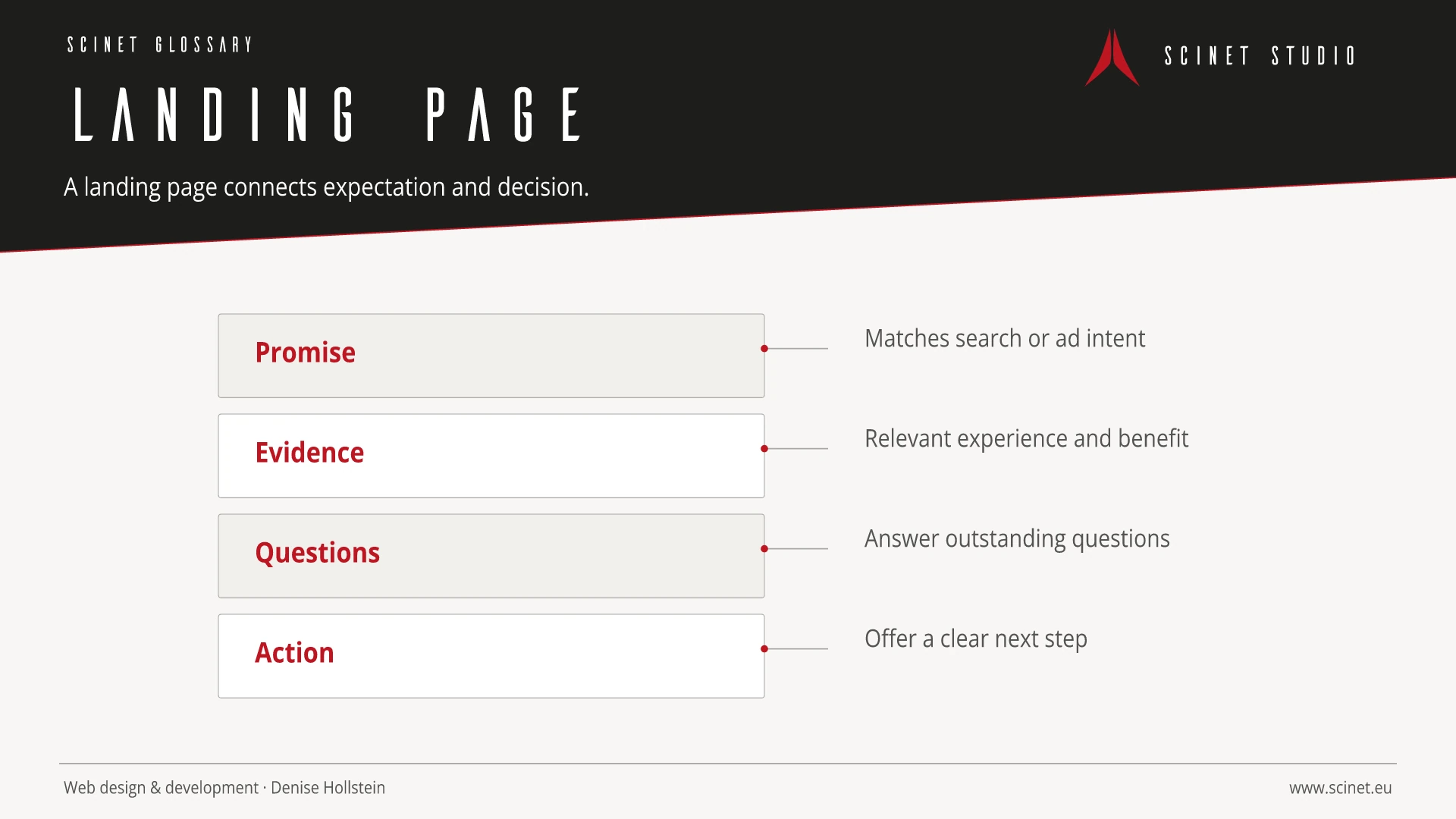
A landing page moves a defined audience from an expectation to an action. Message, proof, objections, form, and follow-up need to be consistent and aligned with the campaign.
Search optimisation starts with a real information or action need, not the longest possible keyword list. A page should perform a recognisable task, provide reliable answers, and be technically unambiguous. Work is prioritised sensibly when potential impact, effort, dependencies, and business relevance are considered together.
Landing Page: relevance to SEO, paid search, and GEO
SEO and paid search often address the same needs but operate through different mechanisms and timescales. Ads can test messages and demand quickly, while organic pages build durable discoverability and depth. Shared query, landing-page, and conversion evidence can improve both disciplines. Budgets and attribution still need separate evaluation so paid traffic is not mistaken for organic success.
For search and answer systems, coverage of Landing Page should distinguish its definition, scope, and evaluation criteria. The editorial reference is “Destination requirements” by Google Ads Help, making central claims traceable for readers and machine-based systems.
Practical code example
A clear opening and focused enquiry form
Heading, value, evidence, and form follow a coherent order. The form asks only for necessary information.
<main>
  <h1>Barrierefreie Unternehmenswebsite</h1>
  <p>Konzeption, Design und technische Umsetzung aus einer Hand.</p>
  <ul>
    <li>Klare Projektphasen</li>
    <li>Responsive und zugängliche Umsetzung</li>
    <li>Persönliche Ansprechpartnerin</li>
  </ul>
  <form aria-labelledby="request-heading">
    <h2 id="request-heading">Unverbindlich anfragen</h2>
    <label for="request-email">E-Mail-Adresse</label>
    <input id="request-email" name="email" type="email" required>
    <button type="submit">Projekt anfragen</button>
  </form>
</main>
Sources and further reading
- Official source Destination requirements Google Ads Help · Checked
