Web design · Development · SEO
SEA (Search Engine Advertising)
SEA explained: paid search engine advertising
Editorially reviewed ·
Clear definition
SEA stands for Search Engine Advertising and refers to paid advertising in search engines. Businesses show ads for selected searches and pay—depending on the campaign and billing model—for clicks or conversions, for example. Google Ads and Microsoft Advertising are well-known paid search platforms.
Unlike SEO, which focuses on organic visibility, SEA can generate immediate reach among defined audiences. Strong performance does not come from high bids alone: search intent, ad relevance, landing pages, audience settings, and reliable conversion tracking must work together. Campaigns should therefore be evaluated against business outcomes such as cost per lead, revenue, or return on ad spend.
SEA (Search Engine Advertising) in practice
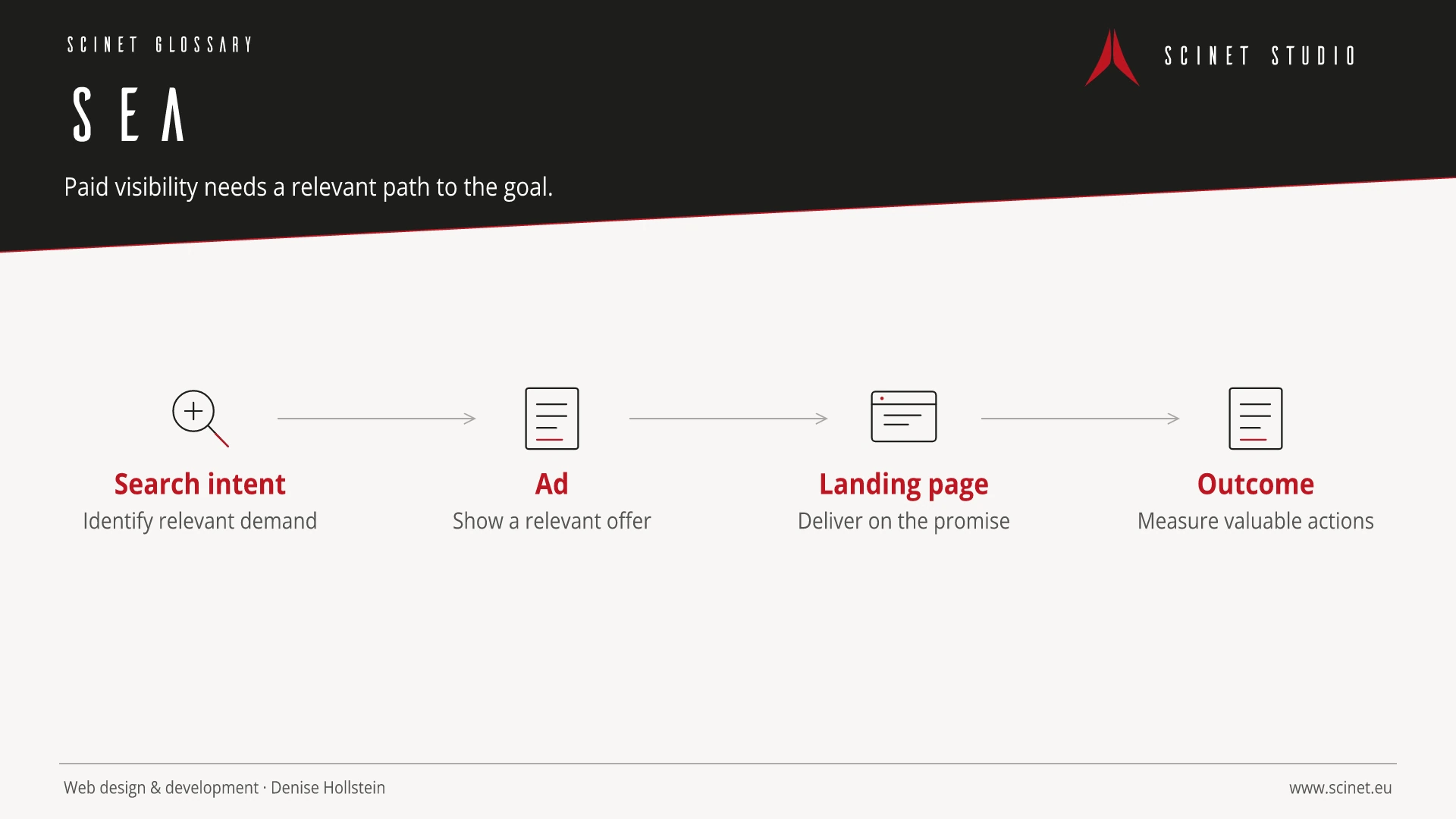
Paid search does not buy guaranteed business outcomes; it buys participation in advertising auctions and potential visibility. Profitability arises only when audience, offer, destination, and measurement work together.
Paid search starts with a clear business objective and a measurable valuable action. Campaign structure, queries, ads, destinations, budget, and bidding need to support that objective together. Changes should be documented and evaluated over sufficiently long, comparable periods. Individual clicks or short-term fluctuations rarely provide a sound basis for decisions.
At a glance
SEA (Search Engine Advertising): relevance to SEO, paid search, and GEO
Click cost and click-through rate do not establish commercial success. Qualified conversions, value, margin, and verified data quality make campaign results meaningful. Search-term reports can reveal questions for organic content, while strong SEO pages can inspire better destinations and messages. The channels should learn from each other but remain separately reported because attribution and cost differ.
For search and answer systems, coverage of SEA (Search Engine Advertising) should distinguish its definition, scope, and evaluation criteria. The editorial reference is “Google Ads basics” by Google Ads Help, making central claims traceable for readers and machine-based systems.
Sources and further reading
- Documentation Google Ads basics Google Ads Help · Checked
