Web design · Development · SEO
RAG Model
RAG explained: augmenting AI responses with external sources
Editorially reviewed ·
Clear definition
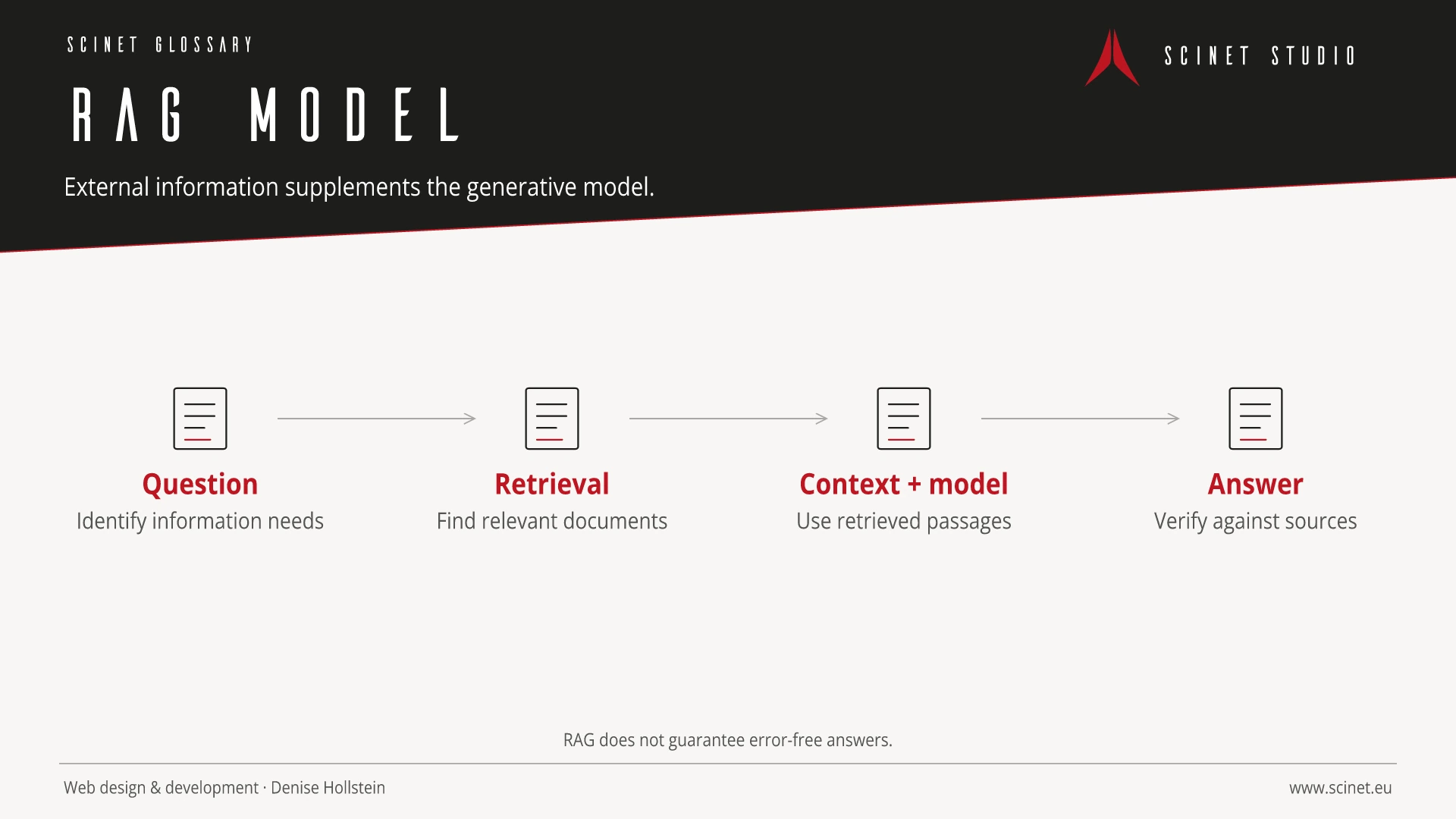
RAG stands for retrieval-augmented generation. A RAG system searches an external knowledge source for information relevant to a query and passes selected passages together with the question to a generative model. Documents are commonly segmented, indexed as embeddings, and retrieved by similarity, although lexical search or hybrid approaches can also be used.
RAG can provide current or internal information and support answers with source references without retraining the base model for every update. It does not guarantee correct answers. Unsuitable documents, missed results, poor segmentation, permission errors, or misinterpretation can still cause failures. Quality requires maintained sources, access control, retrieval and response evaluation, and traceable citations.
RAG Model in practice
RAG augments a generative model with retrieved document passages. Results depend on document quality, chunking, permissions, retrieval, and correct use of the returned evidence.
AI methods model statistical patterns from data. Quality depends on task, data, model, context, and evaluation—not one model-size number or a convincing demonstration. A defensible deployment defines expected outputs, known failure modes, test cases, human approvals, and treatment of confidential information. Cost and latency should also be measured under realistic load.
At a glance
RAG Model: relevance to SEO, paid search, and GEO
Search systems and content workflows increasingly use machine learning, yet discoverability still depends on accessible, unambiguous, useful information. AI can assist research and preparation but does not replace source verification or clear information architecture. For SEO and paid search, the question is whether published content answers a real need more effectively and leads to a reliable next step.
For search and answer systems, coverage of RAG Model should distinguish its definition, scope, and evaluation criteria. The editorial reference is “Retrieval-Augmented Generation for Knowledge-Intensive NLP Tasks” by Meta AI Research, making central claims traceable for readers and machine-based systems.
Sources and further reading
- Research Retrieval-Augmented Generation for Knowledge-Intensive NLP Tasks Meta AI Research · Checked
