Web design · Development · SEO
PHP
PHP explained: server-side web development
Editorially reviewed ·
Clear definition
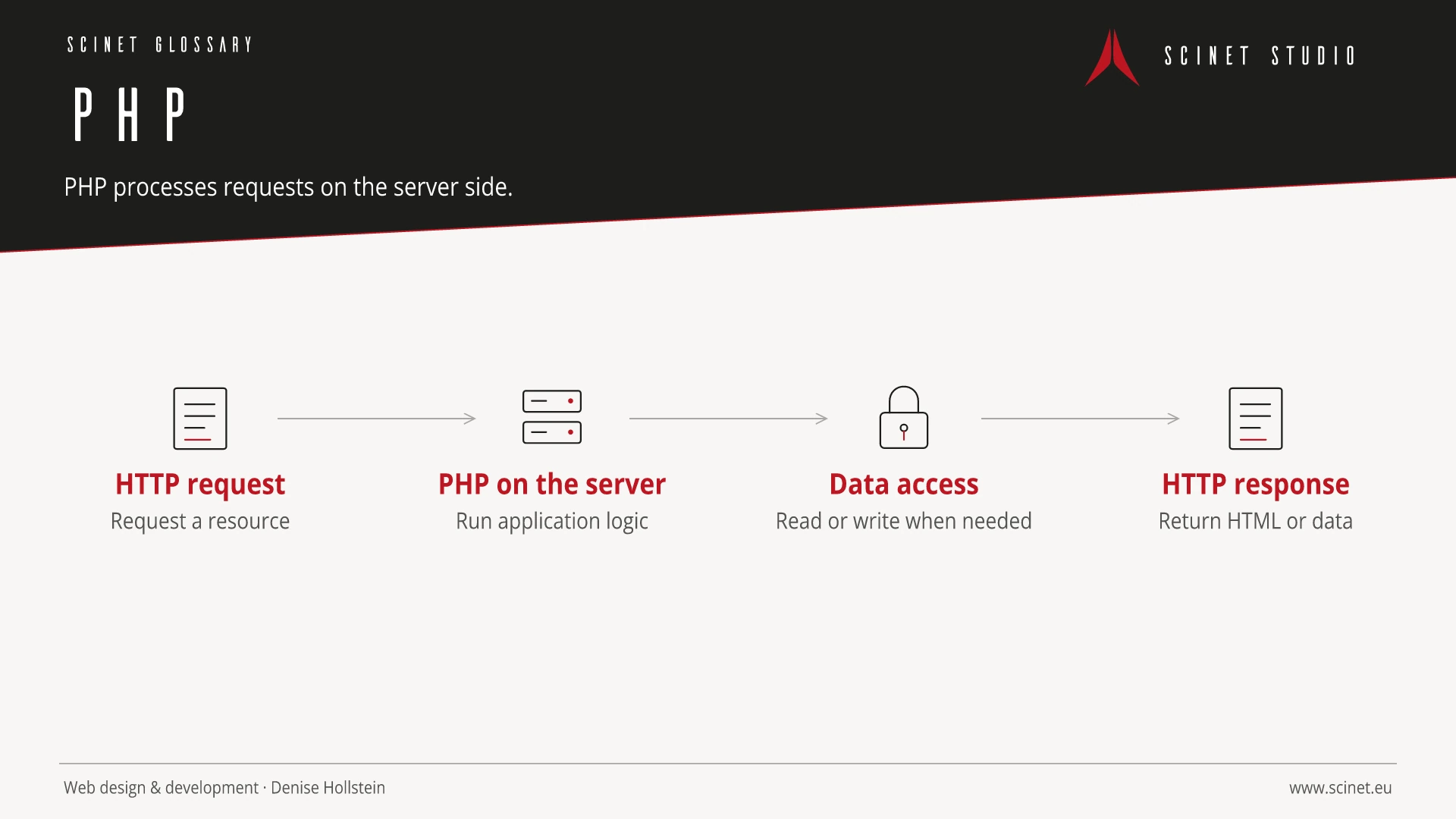
PHP is a server-side programming language widely used in web development. PHP code runs on the server and can process requests, access databases, manage sessions, and generate HTML or other response formats. Content management systems such as WordPress and frameworks such as Symfony are built with PHP.
The language alone does not make an application secure or insecure. Quality depends on architecture, input validation, output encoding, permissions, dependencies, tests, and a supported PHP version. Outdated runtimes and libraries should be upgraded. Established standards, package management, and automated checks are important foundations for new projects.
PHP in practice
Modern PHP benefits from supported versions, clear types, Composer dependencies, and automated tests. Database access should use prepared statements, and error messages must not expose internal details.
Server-side systems often process personal or business-critical data. Inputs must be validated, outputs encoded for their context, and access restricted according to least privilege. Automated tests, reproducible deployments, logging, backups, and clear error handling are equally important. Architecture should reflect real workload and complexity rather than theoretical maximum scale.
At a glance
PHP: relevance to SEO, paid search, and GEO
A stable backend keeps forms, shops, tracking interfaces, and personalised functions reliable. Failed responses or slow processes can waste advertising budget and weaken organic pages. Monitoring should therefore connect technical signals with business events: response time and error rates matter, but so do completed orders, qualified leads, and correctly transmitted conversion data.
For search and answer systems, coverage of PHP should distinguish its definition, scope, and evaluation criteria. The editorial reference is “PHP Manual” by The PHP Group, making central claims traceable for readers and machine-based systems.
Practical code example
Safe database access with PDO
Prepared statements separate SQL structure from input values. The ID is also bound explicitly as an integer.
<?php
$statement = $pdo->prepare(
    'SELECT id, nameDE, descriptionDE
     FROM glossar
     WHERE id = :id AND status = :status'
);
$statement->bindValue(':id', $id, PDO::PARAM_INT);
$statement->bindValue(':status', 'published');
$statement->execute();

$entry = $statement->fetch(PDO::FETCH_ASSOC);
Sources and further reading
- Documentation PHP Manual The PHP Group · Checked
