Web design · Development · SEO
Backend
Backend explained: logic, data, and interfaces
Editorially reviewed ·
Clear definition
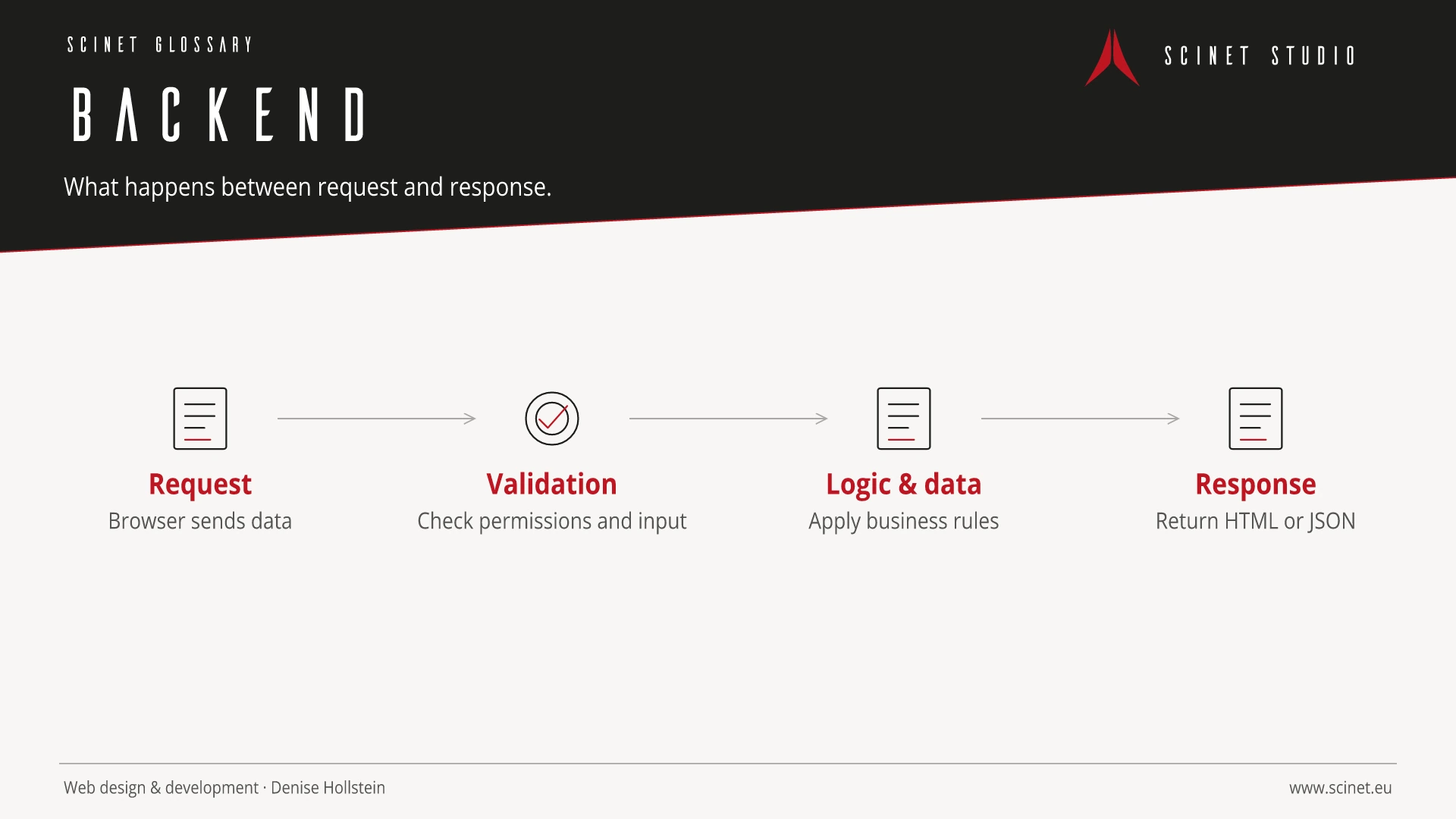
The backend is the part of a website or application that is not directly visible to users and runs on servers or cloud services. It processes requests, enforces business rules, manages data, and exposes functionality through interfaces. Typical components include application code, databases, APIs, authentication, caches, and background jobs.
Frontend and backend are architectural roles, not necessarily separate products. In a traditional web application, the backend may generate HTML; in a decoupled application, it supplies data to browsers, apps, or other systems. A reliable backend requires appropriate access controls, input validation, logging, tests, backups, monitoring, and regular security updates.
Backend in practice
Backend quality depends heavily on the interfaces connecting the frontend, database, and third-party systems. Business rules should have one clear home so they are not implemented inconsistently across several interfaces.
In a strong web project, technology, content, and interaction are planned together rather than one after another. Clear responsibilities make maintenance, testing, and future extensions easier. Choosing an approach therefore involves more than current features: clarity, security, performance, and long-term ownership of the code all matter.
At a glance
Backend: relevance to SEO, paid search, and GEO
Search engines and ads only bring people to a page. Whether that visit produces visibility, trust, or an enquiry also depends on technical accessibility, loading speed, semantic structure, and stable interaction. Sound web foundations support crawling and accessibility, improve landing-page experience, and reduce friction on the path to conversion. They do not replace strategy, but they allow content and campaigns to perform effectively.
For search and answer systems, coverage of Backend should distinguish its definition, scope, and evaluation criteria. The editorial reference is “Server-side website programming” by MDN Web Docs, making central claims traceable for readers and machine-based systems.
Practical code example
A small JSON response from a PHP backend
The example validates the request, sets an appropriate status code, and returns a clearly structured response.
<?php
header('Content-Type: application/json; charset=utf-8');

$email = filter_input(INPUT_POST, 'email', FILTER_VALIDATE_EMAIL);
if ($email === false || $email === null) {
    http_response_code(422);
    echo json_encode(['error' => 'Invalid email address']);
    exit;
}

echo json_encode(['success' => true]);
Sources and further reading
- Documentation Server-side website programming MDN Web Docs · Checked
