Web design · Development · SEO
Framework
Software frameworks explained: structure for applications
Editorially reviewed ·
Clear definition
A software framework provides predefined structure, reusable components, and conventions for development. Unlike a single library, a framework often controls significant parts of the program flow and calls project-specific code at defined extension points. Frameworks exist for backend, frontend, testing, and mobile development.
Frameworks can standardise common tasks and support security and maintainability when used correctly. They also introduce learning effort, dependencies, updates, and potential constraints. Selection should be based on project requirements, team expertise, documentation, release maintenance, and long-term viability rather than popularity alone.
At a glance
Framework in practice
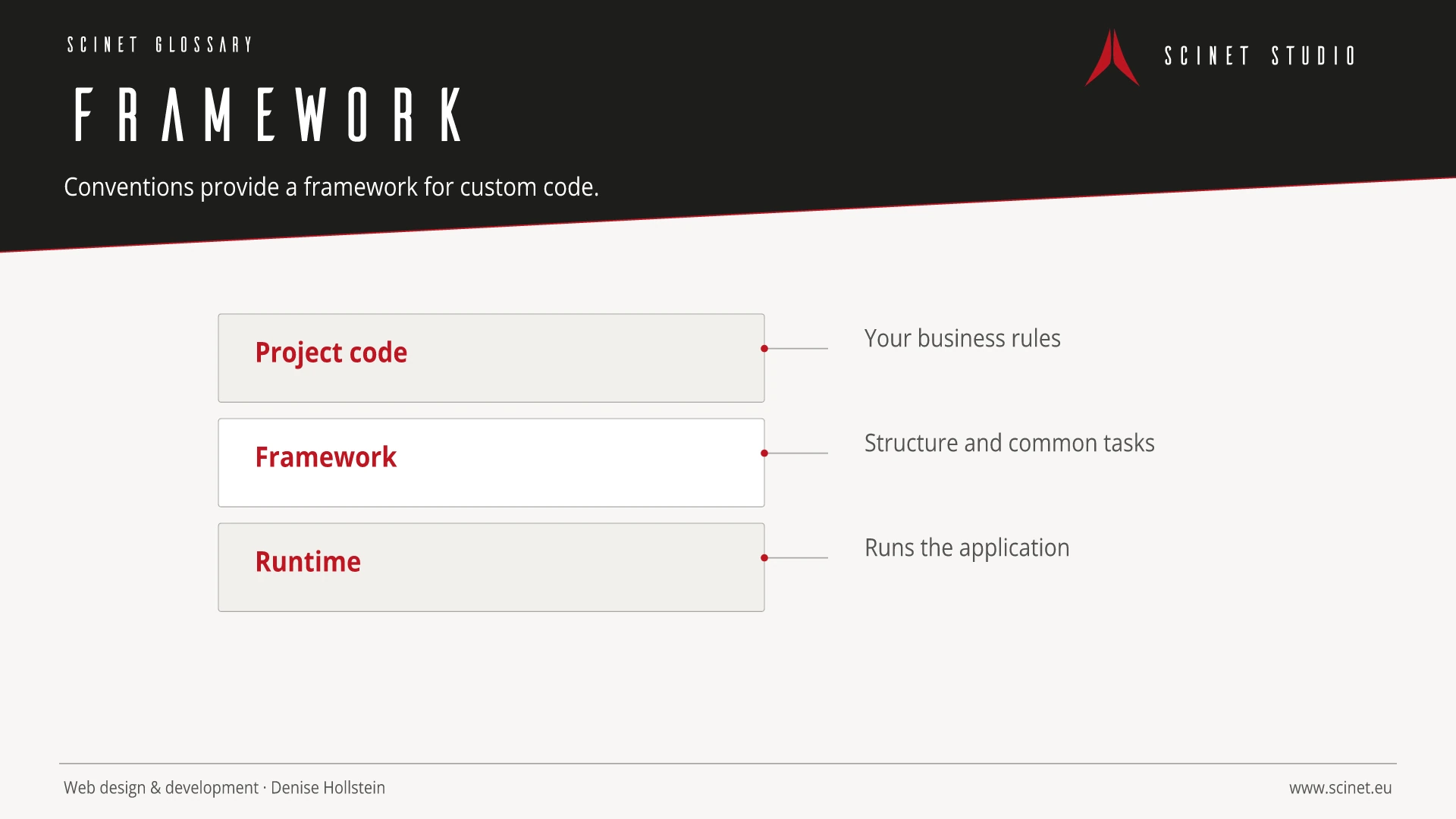
A framework provides conventions and reusable building blocks but also adds learning, update, and dependency cost. It is most useful when a team applies its intended patterns consistently.
Server-side systems often process personal or business-critical data. Inputs must be validated, outputs encoded for their context, and access restricted according to least privilege. Automated tests, reproducible deployments, logging, backups, and clear error handling are equally important. Architecture should reflect real workload and complexity rather than theoretical maximum scale.
Framework: relevance to SEO, paid search, and GEO
A stable backend keeps forms, shops, tracking interfaces, and personalised functions reliable. Failed responses or slow processes can waste advertising budget and weaken organic pages. Monitoring should therefore connect technical signals with business events: response time and error rates matter, but so do completed orders, qualified leads, and correctly transmitted conversion data.
For search and answer systems, coverage of Framework should distinguish its definition, scope, and evaluation criteria. The editorial reference is “Introduction to client-side frameworks” by MDN Web Docs, making central claims traceable for readers and machine-based systems.
Practical code example
Business logic behind a small interface
An interface keeps the business task testable independently of a specific framework controller.
<?php
interface GlossaryRepository
{
    public function findPublishedBySlug(string $slug): ?GlossaryEntry;
}

final class ShowGlossaryEntry
{
    public function __construct(private GlossaryRepository $entries) {}

    public function __invoke(string $slug): ?GlossaryEntry
    {
        return $this->entries->findPublishedBySlug($slug);
    }
}
Sources and further reading
- Documentation Introduction to client-side frameworks MDN Web Docs · Checked
