Web design · Development · SEO
Word Vectors
Word vectors explained: words represented as numerical embeddings
Editorially reviewed ·
Clear definition
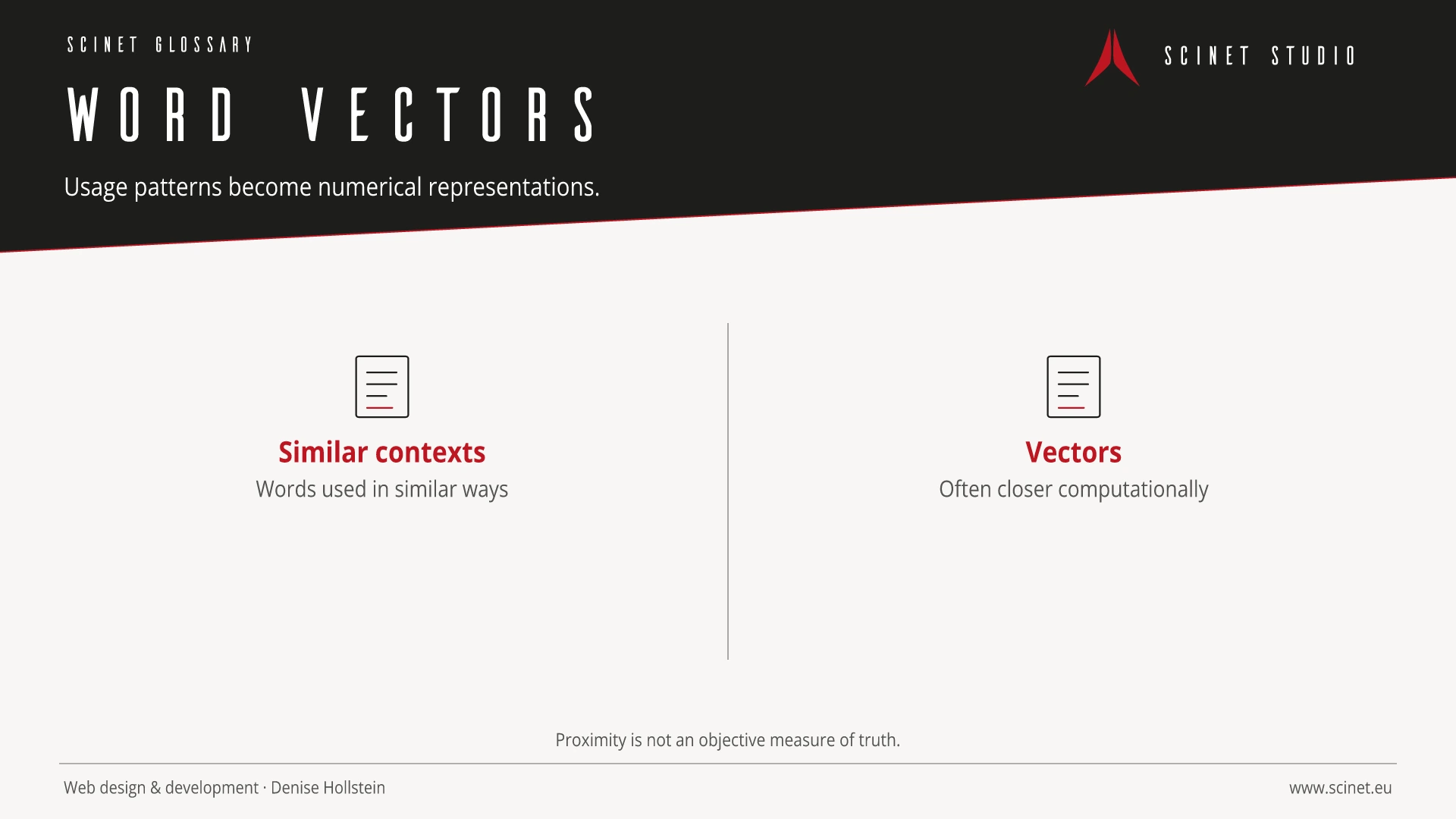
Word vectors or word embeddings are numerical representations of words in a multidimensional space. Learning methods assign vectors according to how words occur in training data, so words used in similar contexts often lie closer together. Methods such as Word2Vec popularised these continuous representations and enabled computational similarity comparisons.
Traditional word vectors generally assign the same vector to a word regardless of its sentence and therefore represent ambiguity only to a limited extent. Contextual language models instead generate representations according to the surrounding text. Distances are not objective measures of meaning or truth: they reflect data, objective, and model and may inherit social biases. Search systems now commonly use embeddings for complete passages rather than isolated words.
At a glance
Word Vectors in practice
Word and text vectors enable computational similarity comparison. Proximity in vector space reflects training patterns, not automatically identical meaning, quality, or factual correctness.
AI methods model statistical patterns from data. Quality depends on task, data, model, context, and evaluation—not one model-size number or a convincing demonstration. A defensible deployment defines expected outputs, known failure modes, test cases, human approvals, and treatment of confidential information. Cost and latency should also be measured under realistic load.
Word Vectors: relevance to SEO, paid search, and GEO
Search systems and content workflows increasingly use machine learning, yet discoverability still depends on accessible, unambiguous, useful information. AI can assist research and preparation but does not replace source verification or clear information architecture. For SEO and paid search, the question is whether published content answers a real need more effectively and leads to a reliable next step.
For search and answer systems, coverage of Word Vectors should distinguish its definition, scope, and evaluation criteria. The editorial reference is “Efficient Estimation of Word Representations in Vector Space” by Google Research, making central claims traceable for readers and machine-based systems.
Sources and further reading
- Research Efficient Estimation of Word Representations in Vector Space Google Research · Checked
