Web design · Development · SEO
SSL (Secure Sockets Layer)
SSL and TLS explained: encrypted connections on the web
Editorially reviewed ·
Clear definition
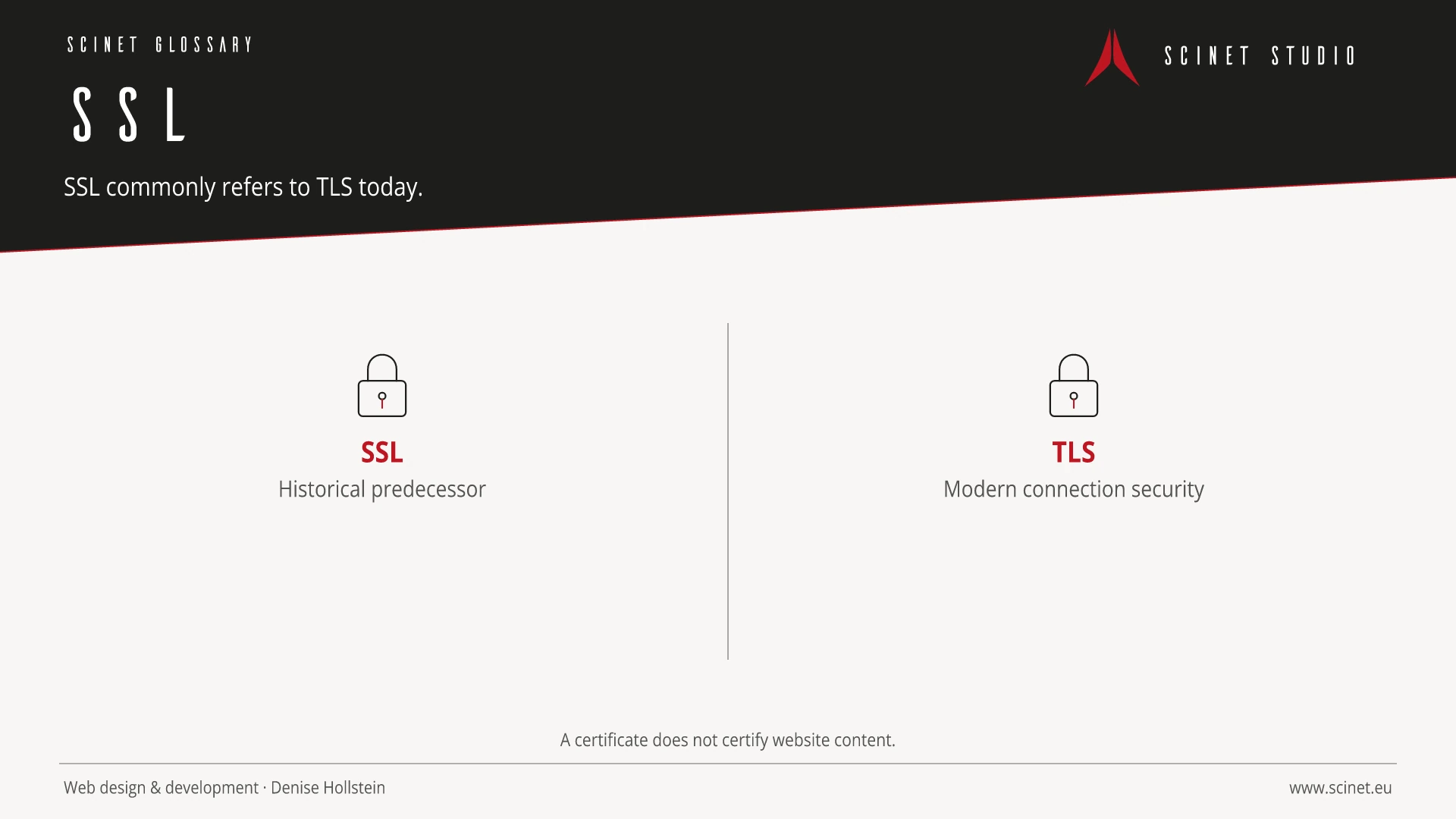
SSL is the historical predecessor of TLS. When people refer to an SSL certificate or SSL encryption today, they generally mean TLS. With HTTPS, TLS protects the connection between client and server against straightforward eavesdropping and unnoticed modification and authenticates the requested host through a digital certificate.
A valid certificate does not prove that a company is trustworthy or that a website contains no malicious code. It primarily confirms control relating to the names in the certificate and enables a protected connection. Secure operation requires current protocols, correct certificate chains, automatic renewal, HTTPS redirects, secure cookies, and protection of the application itself.
At a glance
SSL (Secure Sockets Layer) in practice
On the modern web, TLS is normally meant even though SSL remains the common expression. Certificates need automatic renewal, complete certificate chains, and obsolete protocol versions disabled.
Web infrastructure is usually invisible until something slows down or fails. Changes should be documented, rolled out gradually, and observed through monitoring. Ownership, expiry dates, renewals, and recovery paths belong in an operational plan. When problems occur, examining the complete request path—from browser and name resolution through the network to the application—is more useful than replacing isolated components at random.
SSL (Secure Sockets Layer): relevance to SEO, paid search, and GEO
Availability, secure connections, and short response times affect whether search engines can retrieve content reliably and whether people can actually use a destination page. Infrastructure is therefore an indirect but fundamental part of SEO and paid search. Measurements should represent real regions, devices, and cache states; one fast test from a developer machine says little about the audience’s actual experience.
For search and answer systems, coverage of SSL (Secure Sockets Layer) should distinguish its definition, scope, and evaluation criteria. The editorial reference is “RFC 8446: The Transport Layer Security (TLS) Protocol Version 1.3” by IETF, making central claims traceable for readers and machine-based systems.
Practical code example
Configure a TLS certificate in nginx
The file paths are examples. Certificate issuance, secure protocols, and automatic renewal need to match server operation.
server {
    listen 443 ssl http2;
    server_name example.com;

    ssl_certificate     /etc/ssl/example/fullchain.pem;
    ssl_certificate_key /etc/ssl/example/private.key;
    ssl_protocols       TLSv1.2 TLSv1.3;

    root /var/www/example/public;
}
Sources and further reading
- Standard RFC 8446: The Transport Layer Security (TLS) Protocol Version 1.3 IETF · Checked
