Web design · Development · SEO
MySQL
MySQL explained: a relational database system
Editorially reviewed ·
Clear definition
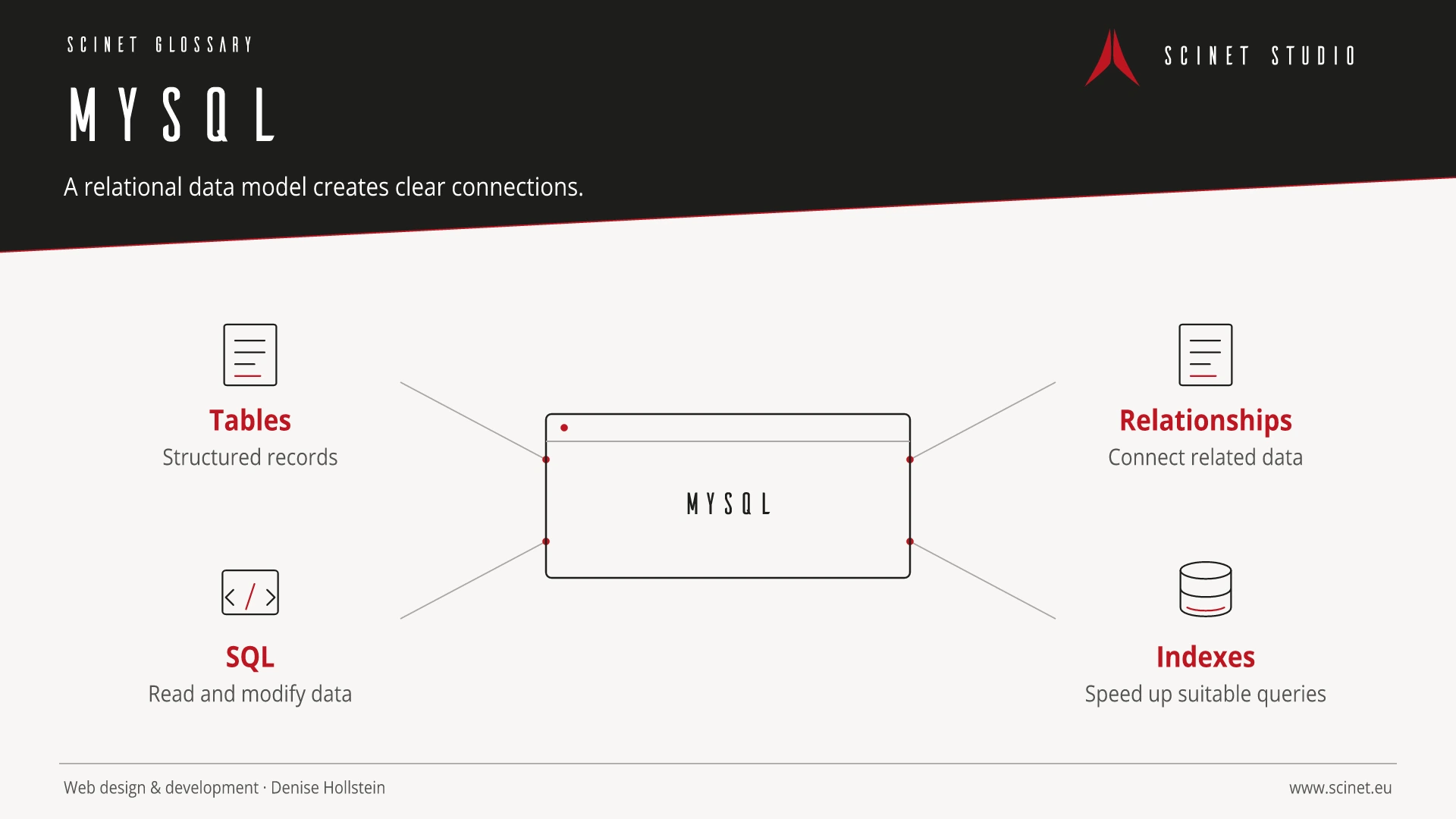
MySQL is a relational database management system. Data is stored in tables with defined relationships and read or modified using SQL. Depending on storage engine and configuration, MySQL supports transactions, foreign keys, indexes, replication, and multiple character sets. It is commonly used as a data store for websites and business applications.
Good database performance is not automatic. Data models, queries, indexes, connection load, storage, backups, and monitoring must fit the use case. Access should follow least-privilege principles, and application values should be bound through prepared statements. Scaling may require optimisation, caching, replication, or architectural changes.
MySQL in practice
A sound data model represents relationships and validity rules in the database. Indexes should be based on real queries; too many or unsuitable indexes increase write and maintenance cost.
Server-side systems often process personal or business-critical data. Inputs must be validated, outputs encoded for their context, and access restricted according to least privilege. Automated tests, reproducible deployments, logging, backups, and clear error handling are equally important. Architecture should reflect real workload and complexity rather than theoretical maximum scale.
At a glance
MySQL: relevance to SEO, paid search, and GEO
A stable backend keeps forms, shops, tracking interfaces, and personalised functions reliable. Failed responses or slow processes can waste advertising budget and weaken organic pages. Monitoring should therefore connect technical signals with business events: response time and error rates matter, but so do completed orders, qualified leads, and correctly transmitted conversion data.
For search and answer systems, coverage of MySQL should distinguish its definition, scope, and evaluation criteria. The editorial reference is “MySQL Reference Manual” by Oracle, making central claims traceable for readers and machine-based systems.
Practical code example
An index for a typical glossary query
The composite index follows the filtered columns. EXPLAIN then shows whether MySQL uses it for the real query.
CREATE INDEX idx_glossar_status_name
    ON glossar (status, nameDE);

EXPLAIN
SELECT id, url, nameDE
FROM glossar
WHERE status = 'published'
ORDER BY nameDE;
Sources and further reading
- Documentation MySQL Reference Manual Oracle · Checked
