Web design · Development · SEO
Duplicate Content
Duplicate content explained: manage duplicate pages correctly
Editorially reviewed ·
Clear definition
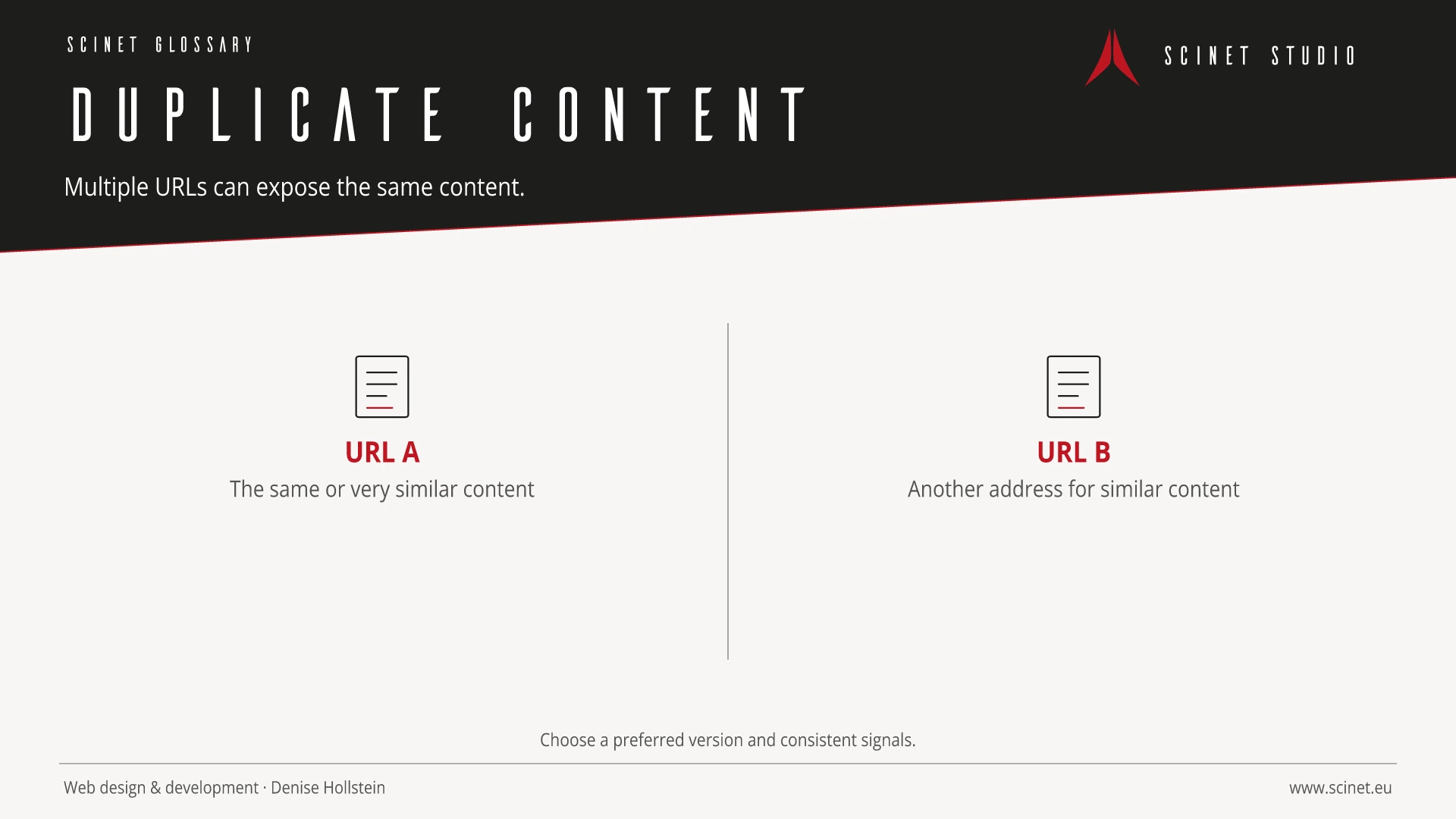
Duplicate content refers to identical or highly similar main content available through multiple URLs. Common causes include print versions, tracking parameters, sorting and filtering, HTTP/HTTPS variants, or products assigned to multiple paths. Such duplication is normal on the web and is not automatically a violation of Google’s spam policies.
Search engines select a canonical URL from similar pages for search presentation. Unclear variants can consume crawling resources, split signals, and complicate reporting. Depending on the cause, solutions include consistent internal links, permanent redirects, rel=canonical, clean sitemap entries, and better parameter or faceted-navigation management.
At a glance
Duplicate Content in practice
Similar content is not automatically a problem. It becomes an issue when several URLs serve the same purpose and split signals; consolidation, redirects, or clear canonicals can then help.
On-page work helps communicate a page’s content, purpose, and preferred URL. Individual fields or metrics should not be optimised in isolation. Titles, main content, internal links, indexing controls, and technical responses need to support the same message. Contradictions often originate in templates or automation and should be fixed systematically rather than page by page.
Duplicate Content: relevance to SEO, paid search, and GEO
Modern search optimisation cannot be reduced to repetition scores or one metadata field. Clear topical coverage, aligned intent, traceable sources, and a good experience are more useful. Search-result and advertising data can reveal wording and information gaps. They should be treated as evidence, not as a reason to overload text with variations of the same phrase.
For search and answer systems, coverage of Duplicate Content should distinguish its definition, scope, and evaluation criteria. The editorial reference is “How to specify a canonical URL” by Google Search Central, making central claims traceable for readers and machine-based systems.
Sources and further reading
- Documentation How to specify a canonical URL Google Search Central · Checked
