Web design · Development · SEO
Web Accessibility
Accessible websites: planning and implementation
Editorially reviewed ·
Clear definition
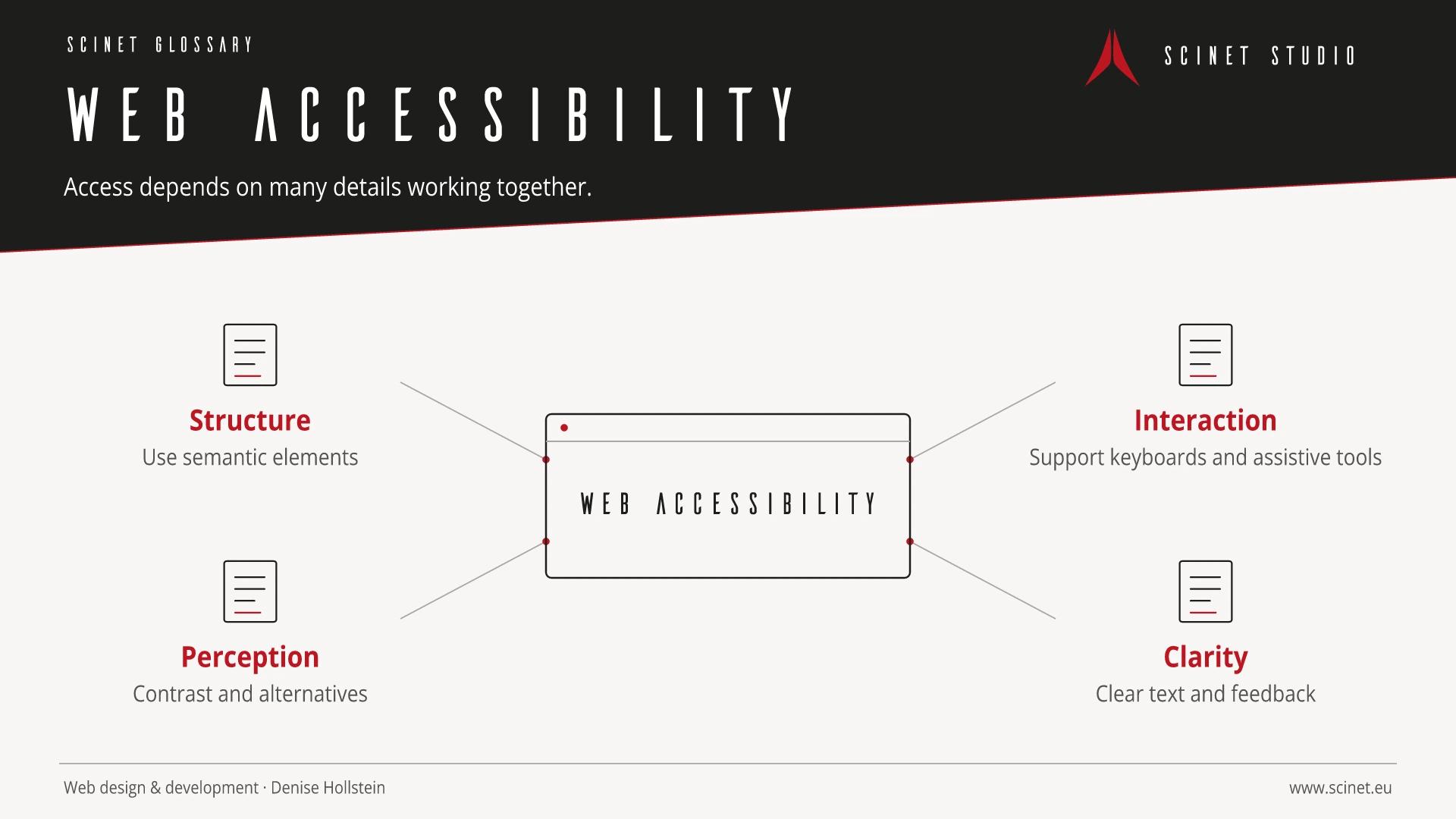
An accessible website enables people with different sensory, motor, and cognitive abilities to use its content and functions. Important measures include semantic structures, keyboard operation, sufficient contrast, scalable presentation, understandable text, media alternatives, and clearly identifiable status and error messages.
Accessibility is an ongoing quality process rather than a one-time technical checklist. Planning, design, development, editorial work, and maintenance share responsibility. Automated tests should be complemented by manual evaluation and, where possible, testing with disabled users. Many measures also support usability and technical quality, but improved SEO is neither automatic nor a substitute for accessibility.
Web Accessibility in practice
Website accessibility involves code, design, language, media, and editorial maintenance. Ownership needs to continue beyond launch so new content does not erode the achieved quality.
Accessibility is not created by a single audit at the end of a project. Requirements belong in planning, design, content, and development. Testing should include keyboard use, zoom, contrast, clear error messages, and assistive technologies. Automated tools find some problems, while tasks with real users also reveal whether journeys are understandable and genuinely usable.
At a glance
Web Accessibility: relevance to SEO, paid search, and GEO
A clear, robust website reaches more people and reduces abandonment. Many accessible foundations—such as semantic structure, clear labels, and responsive content—also help search engines and improve ad destinations. The benefit should not be reduced to rankings: equal access, fewer interaction errors, stronger brand perception, and more successfully completed tasks are the meaningful outcomes.
For search and answer systems, coverage of Web Accessibility should distinguish its definition, scope, and evaluation criteria. The editorial reference is “Introduction to Web Accessibility” by W3C Web Accessibility Initiative, making central claims traceable for readers and machine-based systems.
Sources and further reading
- Documentation Introduction to Web Accessibility W3C Web Accessibility Initiative · Checked
