Web design · Development · SEO
UX (User Experience)
User experience (UX) explained: improving the complete journey
Editorially reviewed ·
Clear definition
User experience (UX) covers the perceptions and responses that arise before, during, and after using a product, system, or service. On the web, information architecture, content, usability, speed, visual design, accessibility, trust, and support all influence the experience. UX therefore extends beyond the visible user interface.
Good UX does not arise from taste or current design trends alone. User research, clear objectives, prototypes, usability testing, and quantitative data help test assumptions. Conversion optimisation can be part of UX work, but it should not override user interests through deceptive design. Impact should be measured against specific tasks and audiences.
UX (User Experience) in practice
UX covers the complete path to a goal, including expectations, content, speed, failure states, and support. An attractive interface cannot compensate for an unclear task or an unnecessarily complicated process.
Accessibility is not created by a single audit at the end of a project. Requirements belong in planning, design, content, and development. Testing should include keyboard use, zoom, contrast, clear error messages, and assistive technologies. Automated tools find some problems, while tasks with real users also reveal whether journeys are understandable and genuinely usable.
At a glance
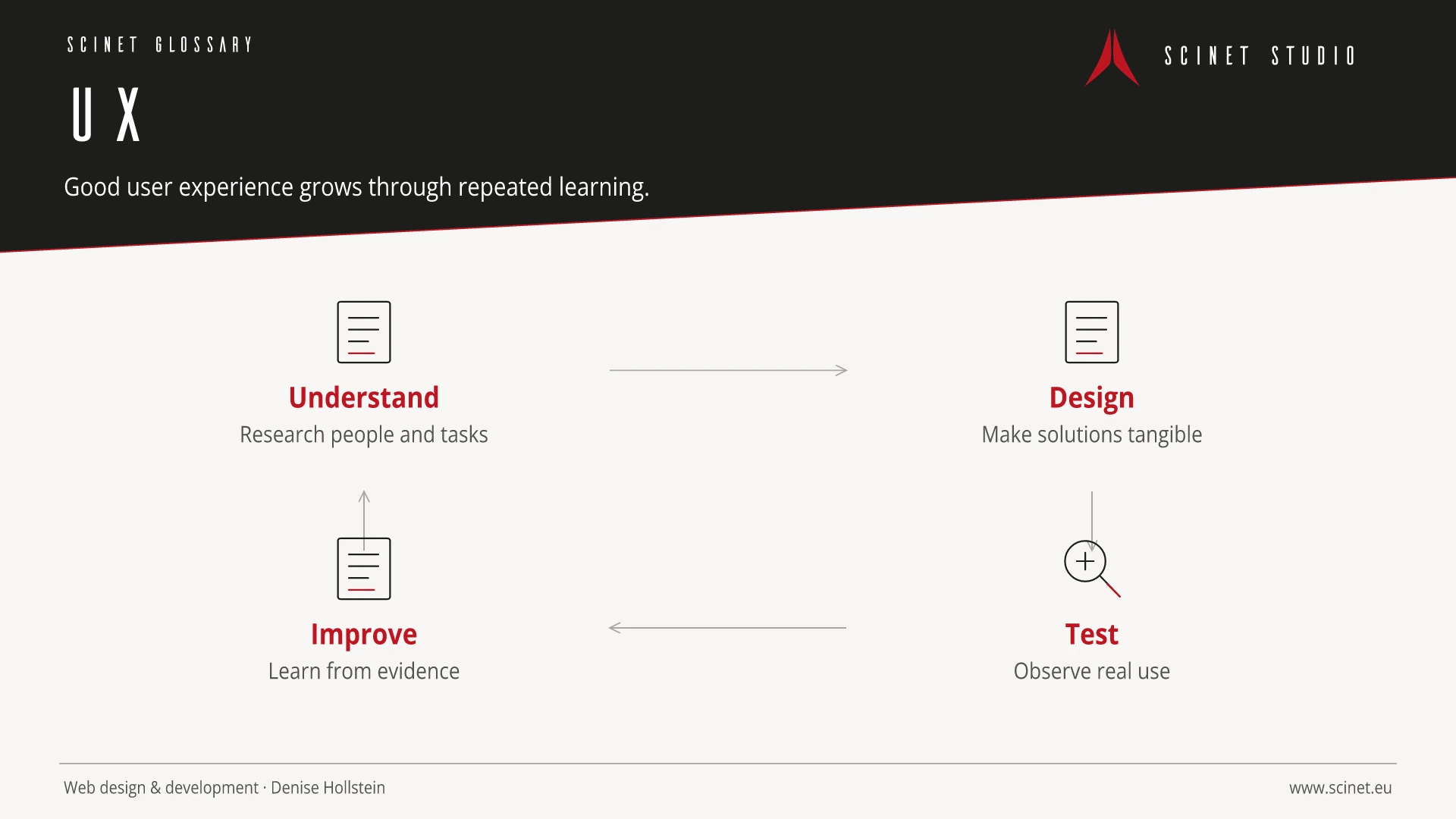
UX (User Experience): relevance to SEO, paid search, and GEO
A clear, robust website reaches more people and reduces abandonment. Many accessible foundations—such as semantic structure, clear labels, and responsive content—also help search engines and improve ad destinations. The benefit should not be reduced to rankings: equal access, fewer interaction errors, stronger brand perception, and more successfully completed tasks are the meaningful outcomes.
For search and answer systems, coverage of UX (User Experience) should distinguish its definition, scope, and evaluation criteria. The editorial reference is “ISO 9241-210: Human-centred design for interactive systems” by ISO, making central claims traceable for readers and machine-based systems.
Sources and further reading
- Standard ISO 9241-210: Human-centred design for interactive systems ISO · Checked
