Web design · Development · SEO
LoRA
LoRA explained: parameter-efficient model adaptation
Editorially reviewed ·
Clear definition
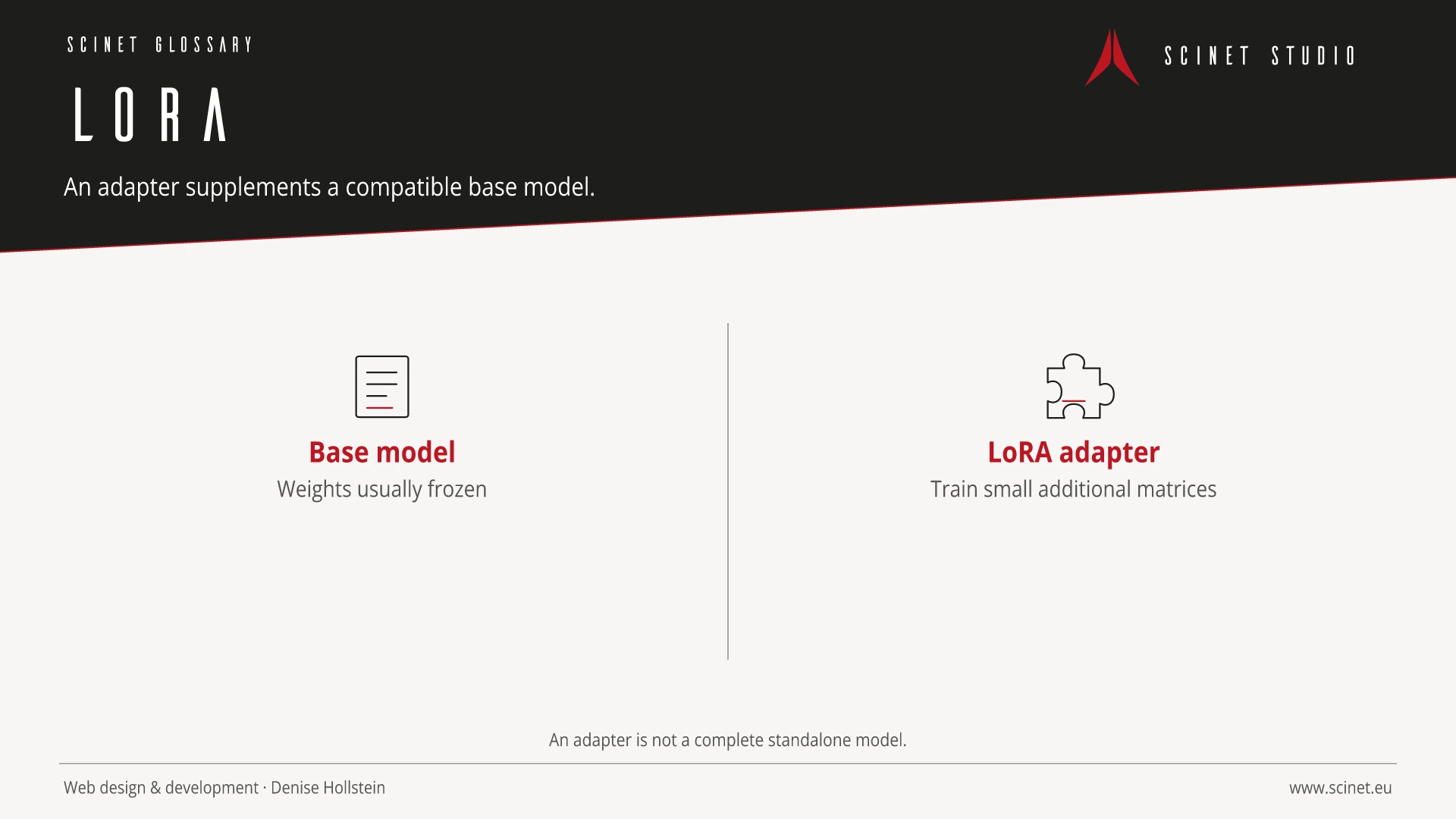
LoRA stands for low-rank adaptation and is a method for parameter-efficient adaptation of pretrained neural networks. Rather than changing all weights, it typically freezes the base weights and trains smaller low-rank matrices for selected layers. The resulting adapters require substantially fewer trainable parameters and less storage than full fine-tuning.
The method was introduced for large language models and is now also used with image and multimodal models. A LoRA file is not a complete model: it requires a compatible base, suitable integration, and often a chosen activation weight. Small file size guarantees neither quality nor safe generalisation. Training data, consent, personality and copyright rights, and the licences of both base and adapter require review.
At a glance
LoRA in practice
LoRA adapts large models through small additional weight matrices without retraining every model parameter. Data quality, base version, training strength, and usage rights determine practical suitability.
Generative image tools can produce variants quickly but need a clear visual objective. Style, subject, format, exclusions, and intended use should be defined first. Outputs require review for anatomical or typographic errors, brand fit, rights, and possible bias. For repeatable production, documented prompts, references, and selection criteria matter more than one lucky result.
LoRA: relevance to SEO, paid search, and GEO
Generated images still need descriptive file names, appropriate alternative text, responsive sizes, and efficient formats. A striking image does not automatically improve rankings or campaigns. It must support the message, work at small sizes, and be usable under the relevant rights. Variants can be tested, but should be evaluated through attention, understanding, and conversion rather than personal taste alone.
For search and answer systems, coverage of LoRA should distinguish its definition, scope, and evaluation criteria. The editorial reference is “LoRA: Low-Rank Adaptation of Large Language Models” by Microsoft Research, making central claims traceable for readers and machine-based systems.
Sources and further reading
- Research LoRA: Low-Rank Adaptation of Large Language Models Microsoft Research · Checked
