Web design · Development · SEO
Diffusion Model
Diffusion models explained: generative AI through denoising
Editorially reviewed ·
Clear definition
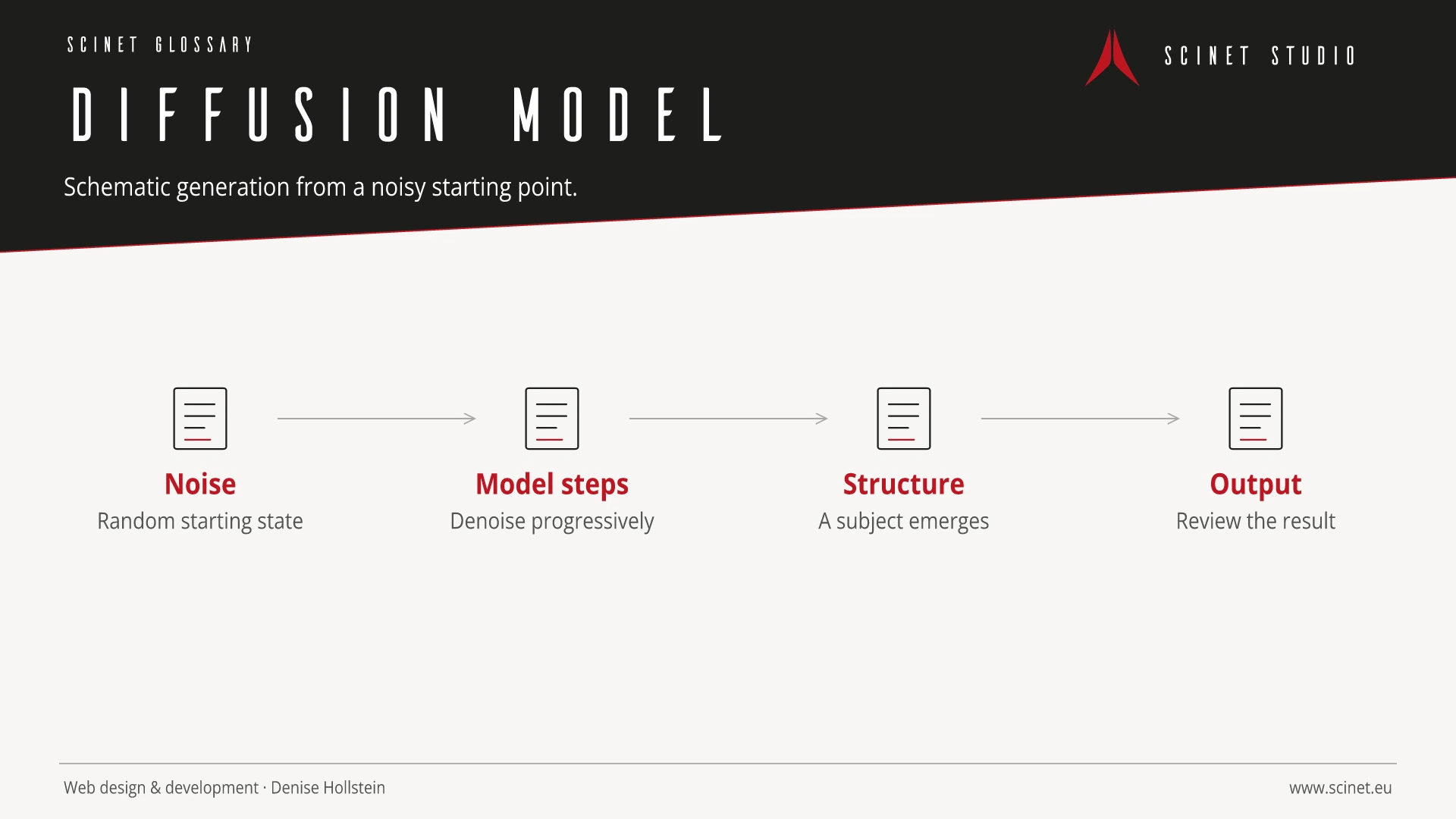
A diffusion model is a class of generative models. Training models a gradual process that adds noise to data and learns its reversal. During generation, the model typically starts with noise and develops a sample through multiple steps. Diffusion models are best known for images but can also be applied to audio, video, and other data types.
Text prompts, reference images, or other conditions can guide generation. Results are stochastic: the same prompt may produce different outputs depending on the initial seed and settings. Quality, speed, and control depend on the model, data, sampler, and compute budget. Generated content is not automatically factual, original, unbiased, or free of rights concerns and requires review before use.
Diffusion Model in practice
A diffusion model learns to remove noise step by step and generate new outputs. Control depends on training data, conditioning, sampling, and post-processing among other factors.
AI methods model statistical patterns from data. Quality depends on task, data, model, context, and evaluation—not one model-size number or a convincing demonstration. A defensible deployment defines expected outputs, known failure modes, test cases, human approvals, and treatment of confidential information. Cost and latency should also be measured under realistic load.
At a glance
Diffusion Model: relevance to SEO, paid search, and GEO
Search systems and content workflows increasingly use machine learning, yet discoverability still depends on accessible, unambiguous, useful information. AI can assist research and preparation but does not replace source verification or clear information architecture. For SEO and paid search, the question is whether published content answers a real need more effectively and leads to a reliable next step.
For search and answer systems, coverage of Diffusion Model should distinguish its definition, scope, and evaluation criteria. The editorial reference is “Denoising Diffusion Probabilistic Models” by University of California, Berkeley, making central claims traceable for readers and machine-based systems.
Sources and further reading
- Research Denoising Diffusion Probabilistic Models University of California, Berkeley · Checked
